District Relevance
Is the member's work directed toward documented needs and interests of Michigan's 4th Congressional District?
- Evidence
- Developing
- Record
- Mixed
- Trend
- New evidence complicating
This site weighs the evidence on whether Michigan's 4th District is well served by its member of the U.S. House, whoever holds the seat. Today that's Rep. Bill Huizenga. The evidence is the member's record: roll-call votes, sponsored bills, committee work, and public statements, checked against who lives here and what the district's economy depends on. The presidency, the U.S. Senate, and the state legislature come in only where they connect directly to that record, such as a federal law that shifts costs onto Michigan's budget, or a vote on whether to end a president's tariff emergency. Every claim links to its source, and the parts of the record that hold up get stated as plainly as the parts that don't.
Last reviewed Sept. 25, 2026 · Corrections log

The district Bill Huizenga represents.
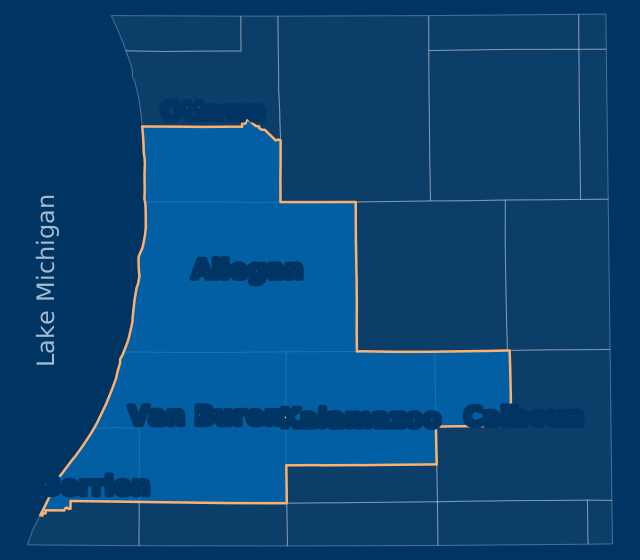
We evaluate the record through four questions: whether congressional activity addresses documented MI-4 needs, whether the policies are durable, whether Congress's institutional responsibilities are exercised consistently, and whether consequential decisions are explained to constituents. The dashboard summarizes the evidence; it does not assign a political grade.
Is the member's work directed toward documented needs and interests of Michigan's 4th Congressional District?
Are the policies economically, fiscally, and institutionally sustainable beyond their immediate political or policy benefits?
Does the member exercise and defend Congress's constitutional and statutory responsibilities consistently, including when doing so may constrain a president of his own party?
Does the member explain consequential votes, policy positions, and uses of congressional authority to the people he represents, including the reasoning, tradeoffs, and consequences involved?
Evidence describes how complete the record is, not how Huizenga performed. Record describes the pattern in the evidence, and Trend describes how the evidence has changed. None of them is a grade, and no overall score is calculated. How to read the dashboard · Open questions · Reviewed Sept. 25, 2026
A rule-based sample of 37 consequential decisions from 2023 to 2026, checked against his releases, newsletters, floor statements, and local interviews.
What his bills achieved next to members of both parties with similar seniority, and the provisions that became law inside larger bills.
Population, income, coverage, industry, farming, and urban/rural makeup, each with its data year, source, and geography.

Huizenga's roll-call record against House Clerk data, his committee assignments and legislative output, and what specific laws and votes mean for MI-4's manufacturing and agriculture base.

What MI-4's makeup should demand of its representative. Where the record holds up, I say that too. A source that only reports the bad news isn't one worth trusting.